

It can help to discuss a relationship through specific questions rather than trying to decide whether love alone will make everything work. Chemistry, compatibility, compromise, cooperation and choice offer five starting points for those conversations.
These five Cs can help you notice what you enjoy, what needs agreement and what you are willing to continue. They do not require a perfect match or a decision to stay together. Both people’s willingness, limits and everyday actions matter.
In this article
Chemistry: notice attraction without treating it as proof
You may feel drawn to someone immediately, become interested over time or enjoy their company without romantic attraction. There is no single feeling that proves you have found the right person or predicts how a relationship will develop.
Notice what the attraction invites you to overlook. You can feel excited and still ask whether plans are reliable, whether a no is respected and whether you want the same kind of connection. Intensity does not settle those practical questions.
You also do not have to force attraction because someone seems suitable. If you want another date, suggest one. If you do not, you can decline respectfully. A useful question is, “Do I want to keep getting to know this person as they are?” rather than whether you have experienced a sign strong enough to guarantee success.
Compatibility: discuss how your lives fit
Compatibility involves more than sharing interests or enjoying the same music. Talk about the choices that affect everyday life: time together, money, family responsibilities, privacy, commitment and plans for the future. You may discover both comfortable similarities and important differences.
Make the conversation concrete. If one person wants frequent spontaneous visits and the other needs advance notice, discuss what can realistically happen. You can compare schedules and expectations without deciding that either preference is defective.
Some differences can be accommodated; others may affect whether you want the relationship. Do not assume that a partner will eventually change a significant wish, such as whether to have children, because the connection feels strong. Understanding the difference helps you make an informed choice together.
Compromise: look for a freely chosen agreement
A compromise works when both people can genuinely agree to it. You might choose an activity neither would have selected alone, alternate plans or find a less expensive option. The result does not need to be mathematically equal at every moment, but each person needs room to question it.
Be clear about what is negotiable. A restaurant choice can be adjusted; consent, safety and a person’s freedom to say no are not bargaining chips. An agreement reached through repeated pressure is not made fair by calling it a compromise.
If you cannot find a workable arrangement, pause and identify the actual conflict. You may need more information, a smaller plan or a decision that you want different things. Giving up an important need merely to end the conversation can leave the issue unresolved.
Cooperation: share the work of following through
Cooperation includes the work after you agree: making a booking, doing a task or communicating a change. Discuss who will do what and when. Include remembering, organising and checking details rather than leaving one person to manage everything invisibly.
For example, instead of agreeing vaguely to spend more time together, choose a plan and decide who will arrange it. If work or care responsibilities interfere, talk about an alternative. A missed plan can be disappointing without becoming proof that someone never cares.
When you need a pause during disagreement, say what you need and when you can return. A pause should allow both people to settle or think, rather than become a threat, disappearance or punishment. If only one person is willing to discuss or carry out changes, notice that limitation.
Choice: decide what you can accept
You cannot make every difference disappear. You might accept a separate hobby, a different social preference or the fact that you will not agree on every opinion. Acceptance is a choice about what you can live with, not a requirement to tolerate harm.
Ask yourself whether you are accepting the relationship that exists or waiting for a person to become someone else. You can care about them and still decide that your needs or plans do not fit. Ending a relationship does not mean that you failed to cooperate enough.
If you both want to continue, choose one agreement to try and decide when to review it. If a conversation brings threats, control or fear, seek support rather than relying on these prompts to make the interaction safe. The point is to understand your choices and act with care, including care for your own limits.
Read the infographic in text
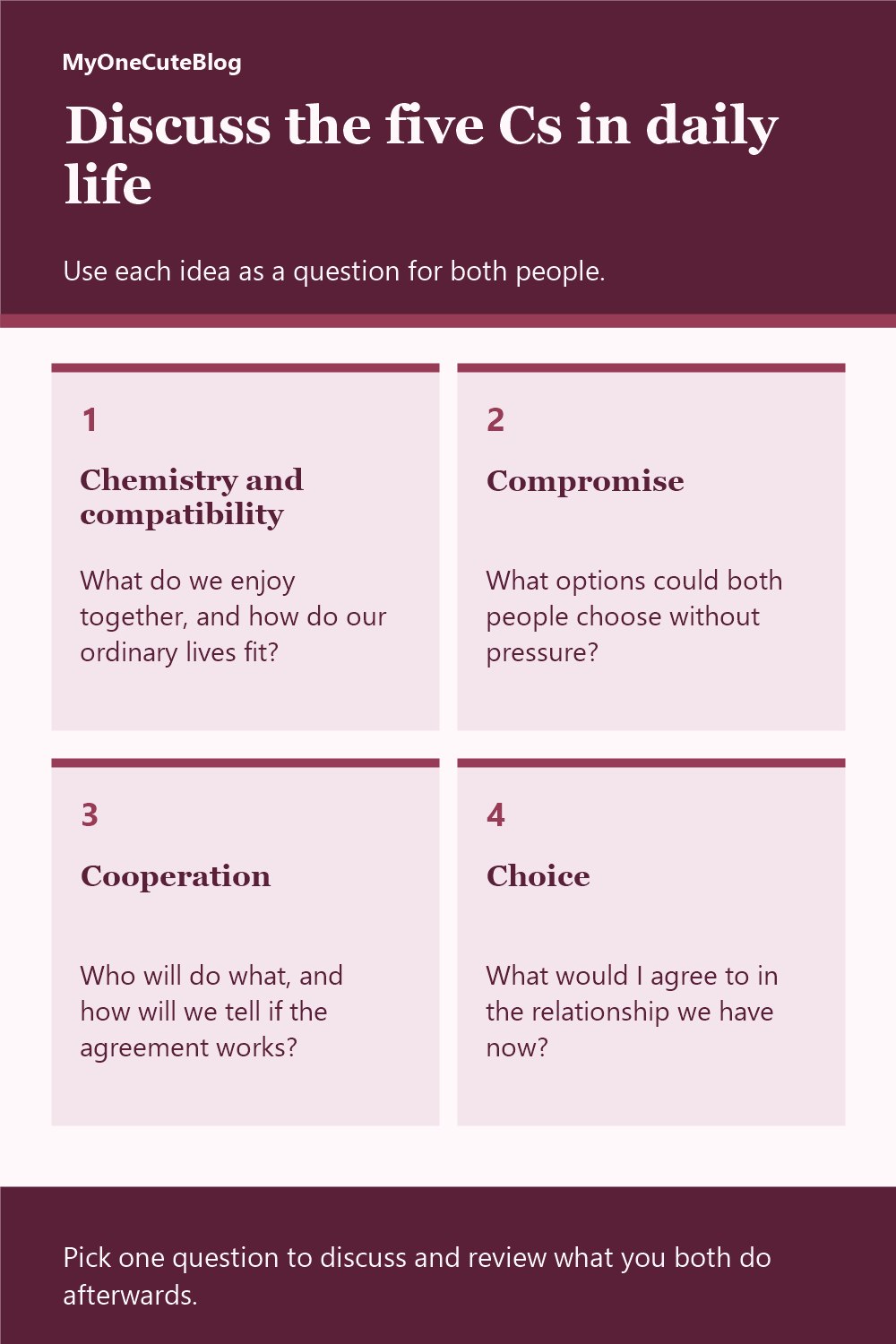
Discuss the five Cs in daily life Use each idea as a question for both people.
- Chemistry and compatibility What do we enjoy together, and how do our ordinary lives fit?
- Compromise What options could both people choose without pressure?
- Cooperation Who will do what, and how will we tell if the agreement works?
- Choice What would I agree to in the relationship we have now?
Pick one question to discuss and review what you both do afterwards.