

Connecting with your inner soul can mean making time for what feels meaningful, noticing your needs and choosing how you want to live. You may understand the soul through faith, spirituality or your own sense of self. You do not need to settle that question before trying a little quiet reflection.
The aim is to understand yourself more clearly, rather than force a revelation or become calm on command. Start with something small enough to fit your day. A few notes, an unhurried walk or a conversation with someone you trust may be more useful than searching for a perfect answer.
On this page
1. Listen to what you need
You do not have to wait for a crisis to pay attention to yourself. Try choosing a quiet moment, with your eyes open if that feels more comfortable. Notice where you are and what is around you. Then ask, “What am I feeling, and what might I need?”
Be specific where you can. “I feel disconnected” might mean you miss a particular friend, have had little time alone or want more affection in your relationship. Those are different needs, and each may suggest a different response. You can be uncertain without treating uncertainty as a failure.
If writing helps, use these three prompts:
- What has been taking most of my attention?
- What has felt meaningful, comforting or interesting lately?
- What would I like a little more or less of this week?
You can keep the answers private. Prayer, time outdoors, music or a familiar ritual may also offer space to reflect if they fit your beliefs. None is a requirement, and a practice does not have to feel profound to be worthwhile.
Meditation is another option. The NCCIH overview of meditation and mindfulness describes possible benefits alongside mixed evidence and possible difficult experiences. If sitting quietly makes you more distressed, stop or choose another activity. There is no need to push through discomfort to prove that you are connecting with yourself.

2. Consider what an inner message means
A thought, dream or strong feeling may seem meaningful. You can value that experience and still take time to consider it. An inner message may point to something you want, fear or have been avoiding; it does not automatically tell you what another person feels or what will happen next.
Separate what you noticed from the conclusion you are drawing. For example, “I feel uneasy after our conversations” is an observation about your experience. “My partner is definitely hiding something” is an interpretation that needs other evidence. Ask what actually happened, whether there is a pattern and what remains unknown.
Try writing three short lines: “What I noticed,” “What I think it means” and “What I could check.” You might check a practical detail, ask a direct question or wait until you are rested before deciding. A decision about a relationship, money or health deserves more than a moment of certainty.
Spiritual reflection can remain part of that process. You do not have to dismiss your beliefs to consider facts, consequences and advice from an appropriate professional. Nor do you have to act immediately because a thought feels urgent or because someone else calls it a sign.
3. Bring reflection into your relationships
Understanding yourself can help you explain a need without asking someone to guess. Turn a broad wish into a clear request: “I miss spending time together. Would you like to have dinner without our phones on Thursday?” The other person can agree, suggest a change or decline, and their answer gives you useful information.
Listening inward also includes noticing your limits. You may want more closeness while needing time alone, or care about someone while deciding that a particular arrangement is not workable. Consider what is yours to choose, what needs mutual agreement and what you cannot control.
A feeling of deep connection does not require you to accept pressure, disrespect or repeated boundary violations. The NHS guidance on relationships and wellbeing includes communication, boundaries and keeping time for your own interests. Pay attention to everyday behaviour as well as how significant a connection feels.
If a conversation becomes circular, take a pause and choose a time to return to it where safe. Reflection can help you find words, but it cannot create mutual understanding by itself. Both people need room to speak and make their own choices.
4. Choose a manageable next step
Finish a reflection by choosing one action you can actually take: arrange a call, ask for help with a task, protect a little rest time or write down a question for a future conversation. Keep it small enough that you can tell whether it happened.
Later, ask whether the action helped and what you learned. You are allowed to change your mind. Connecting with yourself need not become another routine you must perform perfectly, or a way to blame yourself when life remains difficult.
If distress continues, worsens or interferes with sleep, concentration or everyday activities, speak with a healthcare professional. The National Institute of Mental Health’s self-care guidance discusses everyday support and when to seek help. Spiritual practices can accompany care without replacing it.
For today, one honest observation and one kind, workable response are enough. You can leave larger questions open while caring for the life and relationships in front of you.
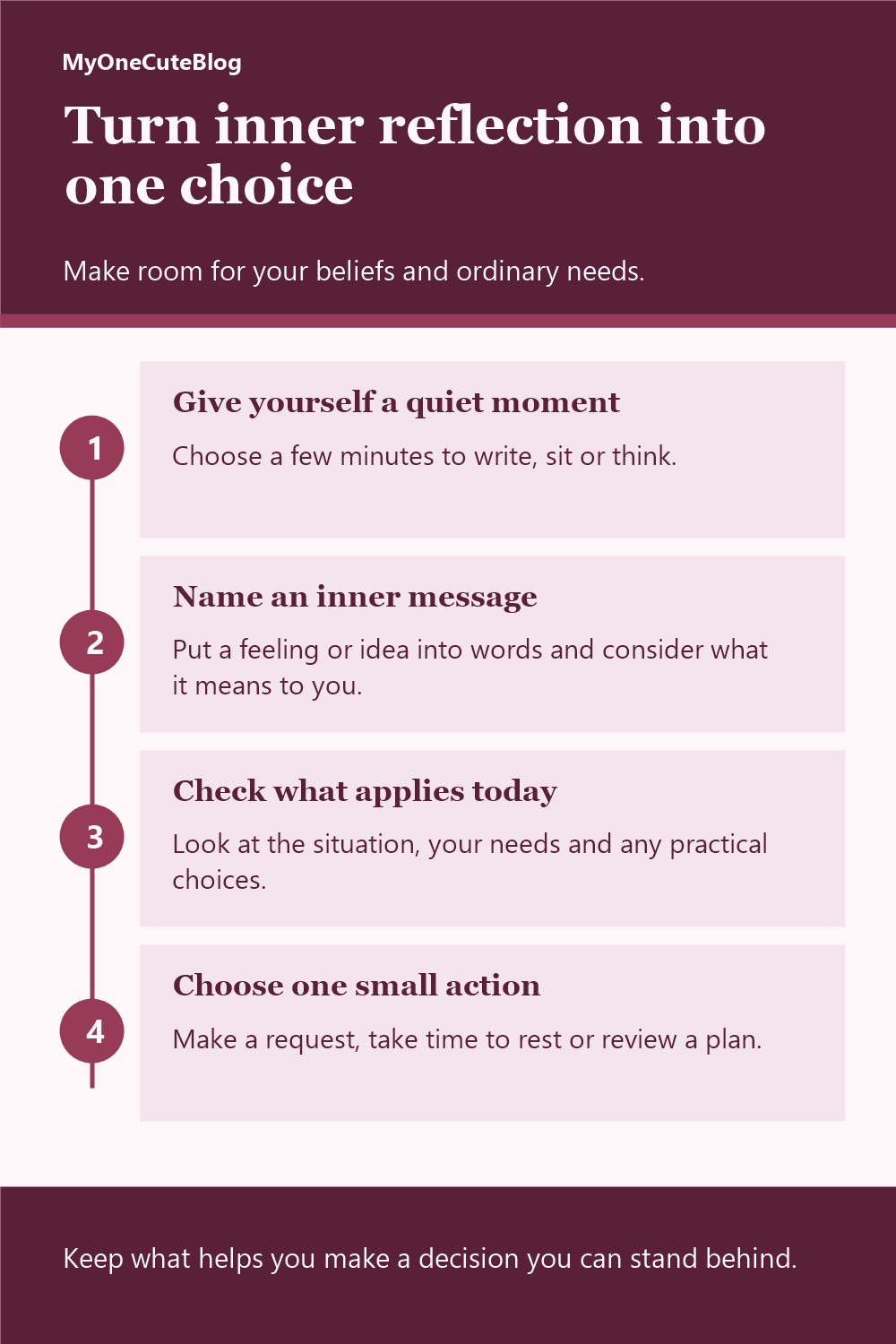
Read the infographic in text
Turn inner reflection into one choice Make room for your beliefs and ordinary needs.
- Give yourself a quiet moment Choose a few minutes to write, sit or think.
- Name an inner message Put a feeling or idea into words and consider what it means to you.
- Check what applies today Look at the situation, your needs and any practical choices.
- Choose one small action Make a request, take time to rest or review a plan.
Keep what helps you make a decision you can stand behind.