

Negotiating relationship roles starts with the work behind the label. Managing meals may mean noticing supplies, planning, shopping, cooking and cleanup; agreeing to one part is not automatically agreeing to all of it.
Discuss what each person can reasonably take on, which decisions need shared agreement and how the arrangement can change. Traditional, unconventional or spiritually meaningful roles still need informed choice, access to resources and the freedom to say no.
Write a role agreement that leaves room for choice
Read the guide as text
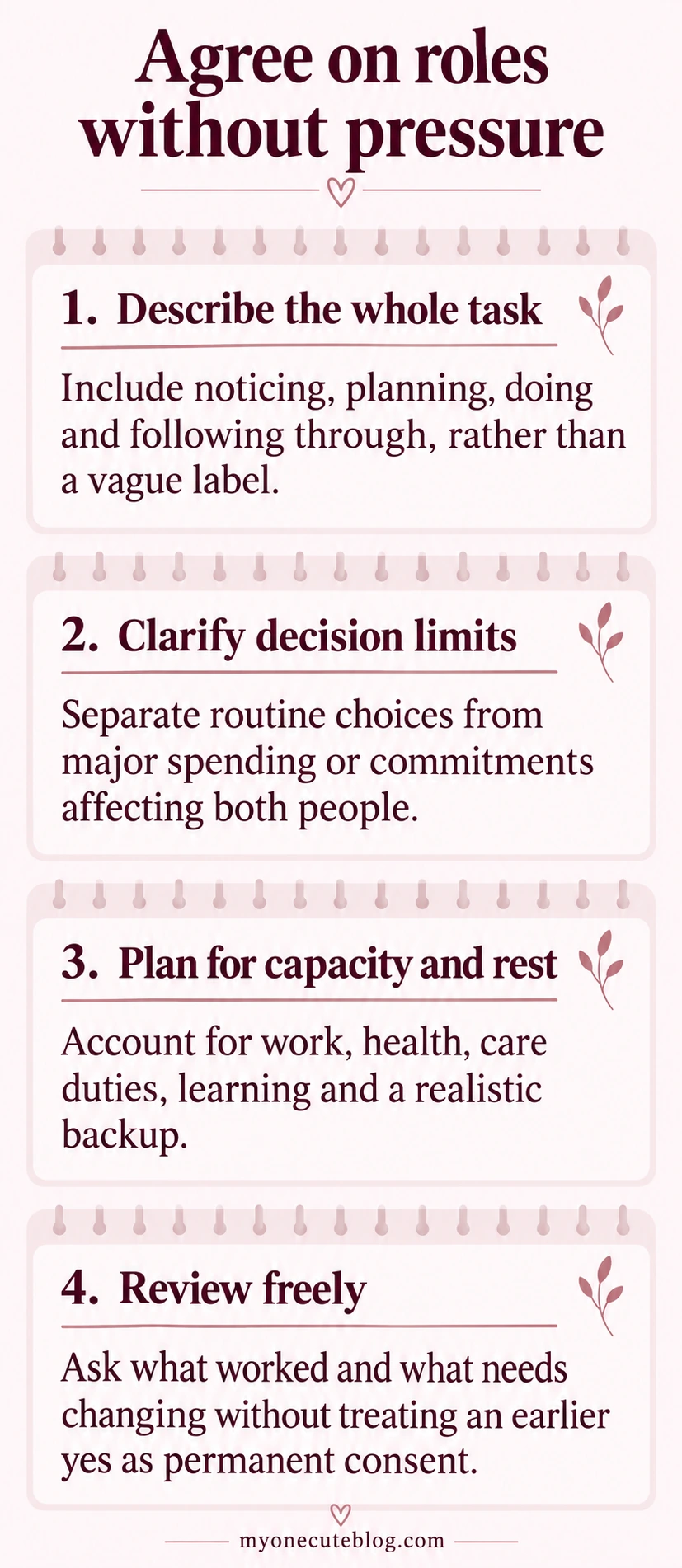
- Describe the whole task. Include noticing, planning, doing and following through, rather than a vague label.
- Clarify decision limits. Separate routine choices from major spending or commitments affecting both people.
- Plan for capacity and rest. Account for work, health, care duties, learning and a realistic backup.
- Review freely. Ask what worked and what needs changing without treating an earlier yes as permanent consent.
Naming the Method and the Role
You should start with the responsibilities, such as "managing the household." This can include making meals, cleaning, setting up appointments, messaging the family, and paying attention when supplies run low. This is such a broad label, though, that it can put several different jobs in one category.
Ask each person to say what they think the role should include. You might find that one person thinks cooking dinner, while another thinks planning, shopping, cooking, and keeping the budget.
Know the difference between responsibility and authority. One person might be responsible for getting the car repaired without being in charge of making an expensive purchase. These are two completely different decisions.
You can take time to write out a plan description, such as: "Managing weekly meals means that you plan the menu, you look to see if any groceries are needed, you shop within the budget, and you prepare the food." This is a description that makes it possible to talk about time limits and changes if needed. Setting vague labels makes it easier for expectations to change without having a conversation.
Understanding the Workload
List tasks that are recurring and require a lot of thinking. Always include noticing, planning, doing, and then making sure things are complete. A task isn't fully transferred to another person if the other person still has to remember it, explain it, and then remind the person to do it.
Don't forget to consider things like work, commuting, caregiving, health needs, and time needed for recovery. Available hours don't tell you what the person has available to do extra tasks, but it should be part of the discussion.
Don't turn the list into a competition over who's more tired. The purpose is to understand what the household needs and what each person can do reasonably.
Asking for Your Partner's Opinion
Preferences do matter, but liking a task doesn't make the workload unlimited for anyone. Someone who likes cooking might still not want to plan every single meal, and someone who's good with money might not want to manage every financial decision on their own.
Ask, "What do we prefer? What can we realistically do, and what would we like to learn or stop doing? The answers might be different. One partner might like a task but not have enough time to do it because they're sick or their job is more demanding at the moment. Someone else might hate a task but choose to take it on because it's part of a fair arrangement."

The Centre for Clinical Interventions explains assertive communication, including expressing needs directly while respecting others. Use that approach to describe capacity without apologizing for having limits or presenting your preference as the only reasonable option.
Agreements Need to Be Chosen
A yes is better when no is a possibility. Ask what happens if either person doesn't want to do the role. Are they going to assault, pressure, restrict, or make threats about the relationship?
If you're disappointed, you should talk about it. Punishing someone because they refuse a role is a completely different thing. Do not assume that a quiet agreement means the person feels free to choose.
You can ask something like, "Would you pick this if you weren't worried about how I would react?" Then allow them to answer honestly, even if you didn't expect their answer. This kind of question only helps if the disagreement is allowed to happen safely.
Consent also needs information. A person can't fairly agree to take on the responsibility if there are a lot of costs, time is involved, or expectations are hidden. Talk about what is known and what isn't known. Having an honest conversation with clear limits is better than a promise that's built just on assumptions.
Independence Isn’t a Game
Household rules shouldn't require someone to give up their access to their own money, friends, healthcare, or privacy. These aren't rewards for doing the role well.
If a person stays home to meet caregiving needs, they still need to understand the finances and have access to resources. A person who earns more money doesn't automatically have more authority over every decision that's made.
And a traditional arrangement doesn't mean that you have to give sex or unlimited availability to your partner. Relationship preferences don't take away consent. Love is respect discusses setting and respecting boundaries. Boundaries can help define what a role includes and what it does not.
If you feel you're not able to access money, communicate privately, or disagree in a safe manner. Contact support. The issue might be control instead of a division of tasks, and negotiating might not be the safest thing to do.
Decide Which Responsibilities Need Both People's Input
When you're sharing household responsibilities with your partner, it's important to understand which decisions each person can make on their own and which ones you should discuss together. Some things are simple enough for one person to handle, while others can affect both of you and deserve a conversation before making a decision.
For example, if your partner is responsible for grocery shopping, they might be comfortable picking different brands of food as long as they stay within your agreed budget. But if they're thinking about making a large purchase, adding a regular expense, or buying something that could affect someone's dietary needs, that's something you should probably talk about together first.
You also don't want to create a situation where one person has to ask permission for every little decision. If someone is responsible for a task, they should have enough freedom to handle it without constantly checking with their partner. But being in charge of something doesn't mean they should make major financial decisions or commitments that affect both people without discussing them.
One thing that might help is talking about which decisions can be made independently, which ones simply need a quick update, and which ones require both people to agree. Think about situations that actually come up in your relationship so you're both clear about what to expect.
When it comes to things like financial contracts, loans, property, or legal responsibilities, it's also important to understand that a personal agreement between partners doesn't always change what you're legally responsible for. Getting independent professional advice might help you understand your obligations before making a major decision.
The goal is to make sure both people have a say in important matters without turning every small responsibility into something that needs approval.
Agree on What's Important Without Controlling Every Detail
Sometimes problems come up when one partner agrees to handle a responsibility, but the other person expects it to be done exactly the way they would do it. If those expectations haven't been discussed, the person doing the task might feel like they're constantly being watched, corrected, or criticized instead of being trusted to handle it.
That's why it's important to understand the difference between things that genuinely need to be done a certain way and things that are simply personal preferences. For example, following medication instructions, handling food safely, or meeting important deadlines are things that need to be taken seriously. But arranging dishes in a cupboard or folding towels a certain way might just come down to how someone prefers doing things.
Instead of focusing on every little detail, try talking about the result you're both expecting. For example, saying, "We need to make sure everyone has clean clothes ready for the week," explains what needs to happen much better than simply saying, "You need to do the laundry right." You can still talk about specific details when they matter, but you don't have to insist that everything be done exactly your way.
But remember that having different preferences doesn't mean someone can ignore their responsibilities altogether. If a task affects both people, it's important to agree on a reasonable standard that works for your household.
You also shouldn't have to constantly remind your partner how to complete the same responsibilities or take over whenever something doesn't get done. Both people should be willing to learn, communicate, and follow through on what they've agreed to handle.
The important thing is finding a balance where responsibilities are shared fairly, expectations are clear, and neither person feels like they have to supervise everything. When both partners understand what's expected and respect each other's ways of doing things, managing everyday responsibilities can become a lot less stressful.
Offer Support and a Backup Plan
A role should talk about what happens when someone gets sick, is traveling, or has disruptions. Without a backup plan, responsibility can cause the person carrying the task to be stressed.
Ask how much notice they need and who can help. Say something like, "If I can't handle pickup, I'll contact a backup person and update you right away." This is a better answer than "I'll try."
Keep the plans realistic because not every family has someone nearby to help, and not everyone has flexible work or extra money. Sometimes the backup plan is lowering the standards or canceling an optional commitment.
Talk about how learning's going to happen. If one takes on a new task, they might need practice or more information. Handing over a task the right way is different from requiring instructions that never end. The person picking up the role should be able to learn, take notes, and get answers instead of making the partner manage every step.
Picking a Period that Fits
Pick a period that fits the responsibilities, such as a few weeks or a complete cycle of the task. Talk about what will change and what you'll look at. You might say something like, "For the next month, you can manage school lunches, which includes planning and cleanup. We'll look at cost, time, and if the children have what they need in a month."
The review shouldn't be a test in which one partner passes. Both people need to talk about what happened, including unexpected work and how it affected their rest, schedules, and other responsibilities.
A trial arrangement doesn't mean continuing if the arrangement becomes unsafe or unworkable. It also shouldn't be used to delay every request indefinitely. The point is to try it and then learn from it instead of arguing about assumptions or who is better at the task.
Always Think About Rest
A plan can look balanced on paper while leaving one person permanently on call. Ask if both people have enough time when they're not responsible for monitoring what's going to happen next.
Rest can include things like alone time, friends, sleep, an activity, or just not being the contact person that day. It shouldn't depend completely on finishing every household task. Think about the quality of time as well as the amount of time. An hour of leisure can still mean that the person is answering unlimited questions about children or dinner, and this might not give the same break as an uninterrupted hour of rest.
Fairness doesn't always have to mean that the same tasks require the same amount of time. It does mean that you should pay attention to how it's affecting each other. If one person's preferred role leaves them with no recovery time, the arrangement needs to be looked at, even if it was originally agreed upon.
Allowing Flexibility with Clarity
Some people prefer flexible roles; others prefer clearly defined responsibilities. Some pick a partner who leads certain areas, or they like relationship labels that have meaning to them. The label doesn't mean whether an arrangement is fair or not.
Ask yourself what happened. Are both people allowed to disagree? Is information available? Can roles change, and are both people's health and independence protected?
Do not assume that if there's an unconventional model, it is empowering, or that a traditional model is coercive. Look at behavior and freedom instead of the name of the model.
You can also choose that a model doesn't fit, even if the other partner likes it. Compatibility means sharing your life and including each other's preferences. You don't have to accept a role because it's fashionable, spiritually meaningful to someone else, or meant to prove trust. The choice should be valid and voluntary, and you should know what kind of choice you're making.
Responding to Changes
A previous agreement is information, but it doesn't mean you give permanent consent. Health, work, family, needs, and time can all change. A person might also understand these rules differently after they live through them.
Start with what's hard and say something like, "This responsibility now takes more time than I'm able to manage." Talk about what can change, what has to happen for the time being, and what kind of support is now needed.
Don't let someone reach beyond exhaustion before their request is heard. Making small adjustments earlier might be easier than waiting until resentment starts taking hold. A change should account for how things affect the other person as well.
Transferring every responsibility abruptly can create a different imbalance. Work towards the change where safety and understanding work together. Of course, if one person keeps refusing to have a discussion, the problem might be that they're not willing to share the responsibility instead of how you're asking.
Writing Down the Agreement
Write down the responsibility, decision limits, and backup and review point. Keep it short enough to talk about without turning the relationship into a contract that wants to negotiate every situation.
You can assign one partner roles, such as managing the car maintenance, keeping appointment details, and checking with partners before the cost exceeds the agreed limit. You can add that, during travel, they have someone else handle the situation. You can review the arrangement if it becomes too much.
This kind of agreement is an example, and it shows how ownership is seen but still allows for shared decisions. It can change as the situation changes. A good role arrangement allows both people to have clarity and to be able to speak safely. You can decide the strengths, common preferences, and household situation while keeping consent, independence, and care as a priority.
Start with one responsibility, describe the entire task, and build an agreement that is easy to live by instead of one that is just accepted because you're talking about it.
Define the whole responsibility
Choose a task to outline its full workload and freely agreed decision limits.
Both people need room to disagree or revise the arrangement. Follow essential care instructions and seek appropriate advice for consequential changes.
Use the questions and examples in the article above; the draft builder needs JavaScript.
15 questions readers ask
1. What does negotiating relationship roles mean?
It means discussing responsibilities, decision-making and the ability to change arrangements rather than assuming familiar patterns are agreed upon.
2. How specific should a role be?
Describe its tasks, limits and expected result. Managing meals might include planning and shopping, or only cooking; make the scope explicit.
3. Is responsibility the same as authority?
No. Someone can arrange maintenance without having sole authority to make a major purchase. Discuss decision limits separately.
4. How do we include invisible work?
List noticing, planning, remembering and follow-through as well as the visible task. A transfer is incomplete if one person still manages every reminder.
5. Does fairness mean identical tasks?
No. Consider capacity, time, difficulty, rest and consequences for each person. Equal task counts may conceal unequal workloads.
6. Can one person lead in a particular area?
Yes, if the scope is informed and freely chosen. Leadership does not remove the other person's rights, resources or ability to disagree.
7. Does liking a task make it my permanent responsibility?
No. Preferences matter, but capacity and wishes can change. Enjoyment does not make the workload unlimited.
8. What makes agreement voluntary?
Either person must be able to question, refuse or renegotiate without threats, punishment or loss of basic independence.
9. Should the higher earner decide more?
Income does not automatically grant authority over another person's choices. Both need relevant information, access and a say in shared commitments.
10. What decisions need joint input?
Discuss decisions that create significant costs, obligations or effects on both people. Use real examples rather than requiring approval for every small choice.
11. How do we avoid micromanaging?
Agree on the result and distinguish essential safety standards from personal preferences. Allow the task owner reasonable room to carry it out.
12. What belongs in a backup plan?
Clarify what happens during illness, travel or disruption, who can help and what can be postponed. Do not assume extra money or nearby family is available.
13. How should we review a trial?
Discuss cost, time, workload, rest and whether needs were met. A review should allow changes rather than grade one partner.
14. Can spiritual beliefs define our roles?
They may inform preferences when both freely choose them. A belief or label should not require surrendering consent, healthcare, money or privacy.
15. What if refusing a role feels dangerous?
Seek confidential specialist support. Threats, forced sex, isolation or financial control require attention beyond a task-negotiation method.