

Caring for a partner sometimes involves adjusting plans or giving something up. That does not make every requested sacrifice fair, necessary or sustainable. Love alone cannot answer questions about cost, choice and responsibility.
These six questions can help you discuss a request before agreeing to it. They can also help you revisit an arrangement that no longer works. Use them where both people can talk freely; if you fear your partner’s reaction, seek confidential support before raising a difficult decision.
On this page
1. Can I choose freely, including saying no?
A sacrifice usually means giving up something you value for a partner or a shared goal. Before deciding whether it is worthwhile, ask whether you can refuse, request time or suggest another option without threats, humiliation or punishment. Agreement under pressure is different from a willing choice.
Name what is being requested. “Move to another city” involves more than a gesture of commitment: it may change work, housing, friendships and access to support. You are allowed to need information before answering. Consent, safety and ordinary privacy are not sacrifices you owe a partner.

2. What would this cost each of us?
Consider time, money, energy, health, care responsibilities and future options. Some costs are easy to miss because they fall on the person who organises arrangements, reduces paid work or manages the consequences afterwards.
Describe the practical effects rather than debating who loves whom more. For a job-related move, you might ask about replacement income, childcare, transport and the cost of moving back. A small favour and an ongoing change to your independence need different levels of discussion.
3. How will we share responsibility?
Fairness does not always mean each person gives up the same thing on the same day. Illness, disability, work and caring demands can change what each partner can contribute. Still, both people should be able to explain their needs and take part in decisions.
Ask what the other person will do to make the arrangement workable. If you take on more household tasks during their busy period, when will you review the division? Avoid relying on an unspoken promise that your turn will eventually come. An agreed plan is easier to discuss than a growing tally of favours.
4. Does my partner understand what I am giving up?
Being willing does not make a cost disappear. Explain the part that matters: “I want to help, and losing my weekly class would leave me with very little time to myself.” Ask your partner to consider that impact rather than assuming they already understand it.
Acknowledgement can include thanks, practical help and a willingness to reconsider. It does not require endless praise. If your concern is repeatedly dismissed as selfish or irrelevant, pay attention to that response before making a larger commitment.
5. Are there alternatives we have not considered?
Start with the underlying need. If a partner wants more time together, cancelling a valued activity may be only one option. You could choose another evening, shorten a different commitment or plan a regular low-cost activity together.
For a larger decision, write down a few realistic options and their trade-offs. Could a change be temporary, shared or tried on a smaller scale? Neither person has to agree that the first suggestion is the only way to show care. If no option meets both people’s essential needs, that difference deserves an honest conversation.
6. Why am I agreeing, and when will we review it?
You may want to support a partner, build a shared future or make an ordinary day easier. You may also fear an argument, feel guilty or worry they will leave. Motives can be mixed; the useful question is whether you can discuss them and make a choice you can live with.
A two-week study of college students in dating relationships found associations between sacrifice motives and reported wellbeing and relationship quality. It does not predict what a particular sacrifice will mean for you. Use your actual circumstances to consider the choice.
If you agree, make the arrangement clear: what will change, what support is needed and when you will check how it is working. You can say, “I can do this for the next month; then we need to review it.” Revisiting an agreement is part of taking its effects seriously, not proof that the original care was insincere.
Compare the choices before saying yes
If one of you would have to do all the travelling, write out the time and cost for two alternatives. You might share the travel, meet somewhere between you or see each other less frequently. Choose one for a month and agree to check whether it still feels fair.
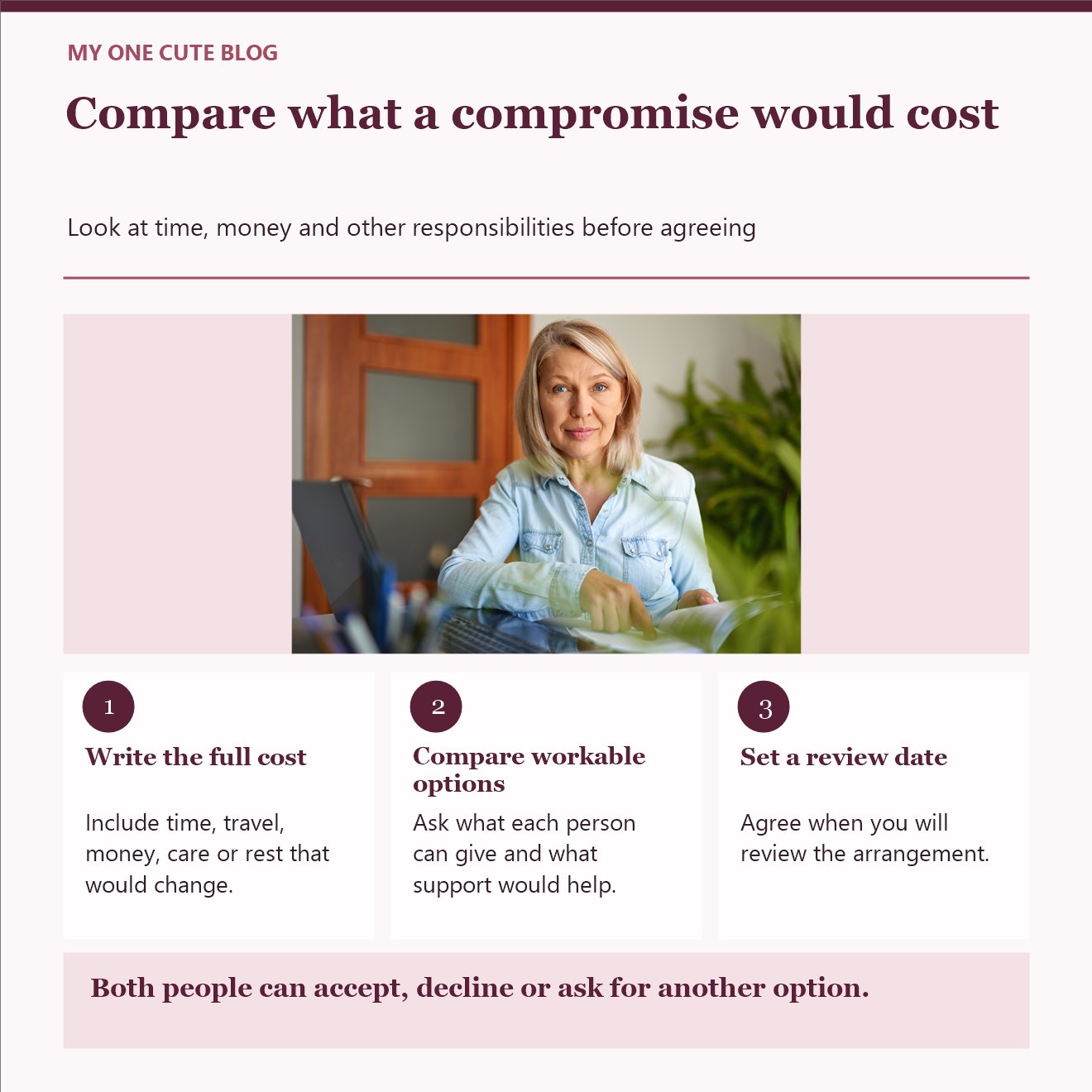
Read the infographic in text
Compare what a compromise would cost
Look at time, money and other responsibilities before agreeing
- Write the full cost Include time, travel, money, care or rest that would change.
- Compare workable options Ask what each person can give and what support would help.
- Set a review date Agree when you will review the arrangement.
Both people can accept, decline or ask for another option.